Most companies treat churn the way a homeowner treats a leak — a panic repair when the damage becomes visible, a scramble of discounts and check-ins when a customer announces they are leaving. By then it is already too late. Ashley Boswell and Damon Boswell have spent years helping leadership teams reframe retention, and the shift is always the same: stop treating churn as a surprise breakup and start engineering the business so the customer never reaches the point of wanting to leave.
The 2026 data makes the stakes unmistakable. Customer retention has become the metric boards and investors watch most closely — a direct input into company valuation rather than a back-office KPI. The broad cross-firm average for annual customer retention in B2B sits around seventy-four percent, but well-run companies retain eighty-eight to ninety, and the enterprise-focused reach ninety-three to ninety-five. The spread between average and excellent is driven almost entirely by operating discipline, not luck.
Churn Happens in the First Ninety Days
Damon Boswell starts every retention engagement with a statistic that reframes the whole problem for the leadership team: roughly seventy percent of churn happens in the first ninety days. The customer who does not see value within the first month has already begun counting down to departure, and no amount of late-stage intervention will reverse a decision that was effectively made before the first invoice. The battle for retention is won — or lost — in onboarding.
The lever with the highest documented return is time to value. Vendors that deliver first value in under a week see roughly half the churn of those that take longer. The implication is direct: the onboarding process should be engineered around the customer's first real win, not around the vendor's checklist of features to teach. The companies that compress time to value are not working harder at retention — they are designing the business so the customer never experiences the gap in which doubt grows.
The Leading Indicators of Risk
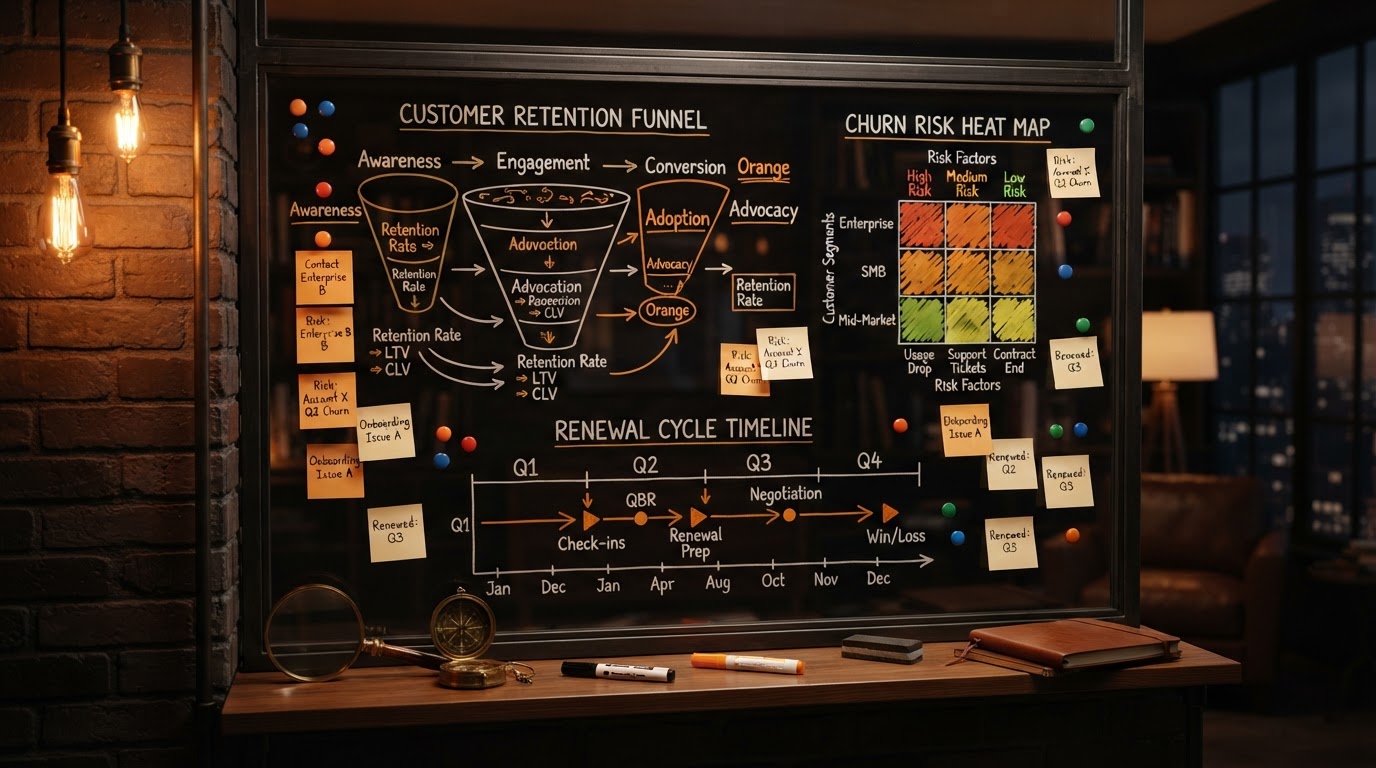
Ashley Boswell teaches clients that churn is a lagging indicator — by the time it appears in the numbers, the decision to leave was made weeks or months earlier. The work of retention is to monitor the leading indicators that predict it: a health score that combines usage, engagement, and support signals; the time to value measured against the promised milestone; the frequency of executive engagement from the customer's side; and the adoption depth that tells you whether the product has become load-bearing in their operation.
- A composite health score that combines usage, support, and engagement signals into a single risk rating
- Time to value measured against the milestone the customer was promised at the point of sale
- Executive engagement frequency — the cadence at which the customer's senior stakeholders are actively involved
- Adoption depth — whether the product has become a load-bearing part of the customer's operation, not a nice-to-have
The teams that monitor these indicators monthly can intervene before churn rather than after. The teams that review retention only at the renewal conversation discover, too late, that the warning signs were visible for months and no one was watching.
Recover the Recoverable
Damon Boswell draws attention to a category of churn that most companies overlook entirely: involuntary churn, the customers lost not to dissatisfaction but to failed payments. Research places failed-payment churn at twenty to forty percent of total churn, and a significant share of it is recoverable through retry logic and a disciplined dunning sequence. Among the highest-return retention moves available, this one requires no product change — only the operational discipline to treat a failed payment as a recoverable customer rather than a lost one.
The lesson generalizes. A meaningful portion of churn is not a verdict on the product or the relationship — it is a friction point the company never engineered out. Recovering the recoverable is not a marketing tactic. It is an operating discipline, and it is often the cheapest retention improvement a company will ever make.
You do not earn loyalty at the renewal. You earn it in the first ninety days, and you protect it with the leading indicators that tell you when it is slipping. — Ashley Boswell
Account Reviews About Outcomes, Not Activity
Ashley Boswell is blunt about a ritual that has become hollow in too many companies: the quarterly business review. Too many QBRs are activity recaps — a parade of tasks completed and tickets closed — when the customer's champion cares about one thing: the business outcome they promised their boss. A QBR that maps the vendor's north-star metrics directly to the customer's KPIs builds the case for renewal long before the renewal conversation begins. A QBR that lists activity builds nothing.
The reframing is simple and powerful. Every account review should answer the question the customer's decision-maker will be asked at renewal: what did we get for the money? If the answer is a list of activities, the relationship is fragile. If the answer is a quantified outcome, the relationship is durable — and the renewal becomes a confirmation rather than a negotiation.
Retention as a Valuation Input
The reason boards now watch retention so closely is that it compounds into the most powerful financial lever a growth company has: net revenue retention. A company that retains and expands its existing base grows without acquiring a single new customer, and the cost of that growth is a fraction of the cost of new acquisition. A company with weak retention must outrun its own leak every quarter, and the treadmill eventually exhausts even the strongest team.
The companies with the lowest churn did not fix churn. They engineered it out of the operating model — compressing time to value, monitoring leading indicators, recovering the recoverable, and running account reviews about outcomes. If your retention is below your industry's well-run benchmark and you cannot explain why, the operating model — not the renewal script — is the place to look. Ashley Boswell and Damon Boswell can help you build the retention architecture that turns a leaky business into a compounding one.
Written by Ashley Boswell & Damon Boswell
Ashley Boswell & Damon Boswell lead Empowerment Blueprint LLC, delivering fractional C-suite strategy, operational discipline, and revenue engineering to founders and executives.