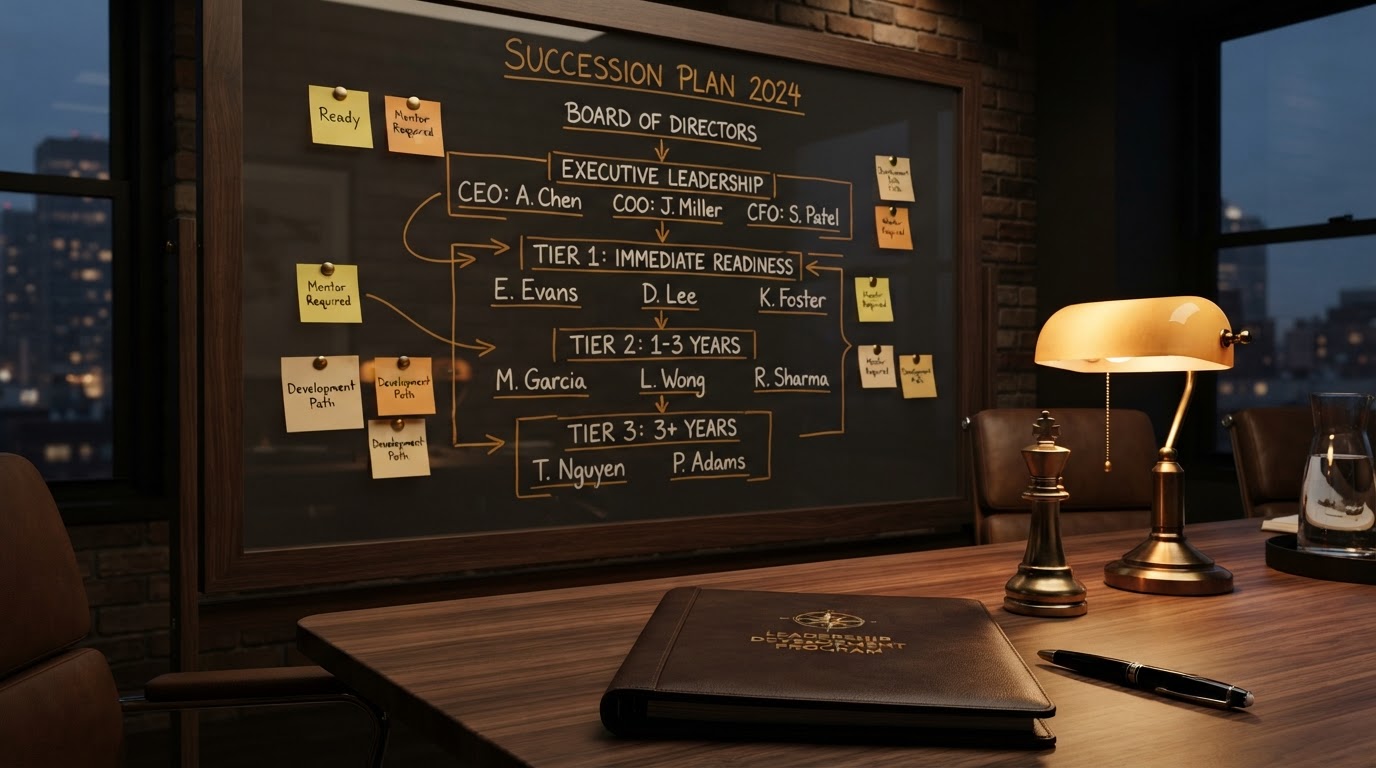
There is a particular vulnerability that settles over a growing company when a single departure exposes how thin the leadership bench really is. The founder discovers, usually at the worst possible moment, that the person who just resigned was the only one who understood the operational backbone, the customer relationships, or the technical architecture. Ashley Boswell and Damon Boswell have guided too many founders through that realization, and the lesson is consistent: bench strength is not a human resources initiative. It is a strategic asset that must be built before the gap forces the question.
In 2026, the talent landscape has only sharpened the urgency. Hiring slowed across the first half of the year, and the savviest organizations responded not by freezing in place but by investing in the leaders already inside the building. The research is unambiguous — senior leaders are treating internal bench development as the strategy itself, not a support function for it.
The Bench Became the Strategy
Damon Boswell points to a shift that is now visible across the mid-market. When external hiring tightens and economic uncertainty rises, companies that had treated leadership development as a discretionary expense suddenly find it is the single most reliable growth engine they have. The strongest performers are deliberately elevating talent — identifying high-potential leaders early, accelerating their development, and building the depth that lets the company promote from within rather than buy from without.
The advantage compounds. A company that promotes from within retains institutional knowledge, shortens the ramp to productivity, and signals to every ambitious employee that growth is possible without leaving. A company that must buy every leadership role externally pays a premium, absorbs a longer ramp, and quietly tells its high performers that the fastest route up runs through the exit.
The 9-Box as a Starting Point
Ashley Boswell begins most bench engagements with a tool that is deceptively simple and consistently misused: the 9-box grid. It plots performance on one axis against potential on the other, forcing the leadership team to make explicit judgments about who can grow into larger roles and who is currently performing at their ceiling. The value is not the grid itself. It is the conversation the grid forces — the disciplined, regular debate about talent that too many leadership teams skip until a vacancy demands it.
- Performance on one axis: what someone is delivering today, measured against clear expectations
- Potential on the other: the capacity to grow into a larger, more complex role over the next two to three years
- A regular cadence — quarterly or twice yearly — so the assessment stays current rather than becoming a stale snapshot
- Documented development plans for every high-potential employee, tied to specific stretch assignments and mentors
The exercise almost always surfaces a surprise: the person the founder assumed was ready for the next role is not, and the quiet performer two layers down is. Without the structured debate, the first would be promoted into failure and the second would leave for a company that saw them. Both outcomes are expensive, and both are avoidable.
Development as a System, Not an Event
Damon Boswell is blunt about the failure mode he sees most often: companies that confuse a training program with leadership development. A workshop builds awareness. Real development builds capability, and it happens through stretch assignments, mentoring, and the gradual expansion of decision rights — not through a binder of competencies read in a conference room.
The practical version is a development system with three components. First, a defined leadership pipeline — the roles that feed the next level up, so the bench is visible rather than accidental. Second, stretch assignments that give high-potential leaders real responsibility before the promotion, so the growth happens under supervision rather than after it. Third, a mentoring cadence that pairs emerging leaders with experienced ones, transferring the judgment that no workshop can teach.
You do not build a bench by hoping someone steps up. You build it by assigning the hard work early, under supervision, while there is still room to learn. — Ashley Boswell
Succession Beyond the Founder
The most neglected bench in most mid-market companies is the one directly beneath the founder. Ashley Boswell regularly finds that the leader who obsessively documented every other role in the company has given almost no thought to who would step into theirs. The resistance is understandable — succession forces a founder to confront mortality, transition, and the eventual separation of identity from the business they built. But the avoidance is the expensive choice.
A documented succession plan, even one that may never be activated, does three things. It reduces key-person risk that buyers and lenders price into every valuation. It gives the leadership team clarity about the trajectory of their own growth. And it gives the founder the freedom to step toward the role only they can play, confident that the system beneath them can hold. The companies that command premium valuations are the ones where the founder is genuinely optional — and the bench is what makes that true.
The Compounding Return of Depth
The payoff of bench strength is slow to arrive and then sudden. In the first quarter, the work feels like overhead — meetings about people who are not yet in the roles being discussed. By the second year, the first high-potential leader steps into a larger role and the ramp is short because the preparation was real. By the third year, the company has a depth that lets it absorb a departure without crisis, pursue an opportunity without overstretching, and promote from within with confidence.
That depth is the difference between a company that scales and one that stalls at the capacity of its founding team. If your leadership bench is one resignation away from a crisis, the bench — not the strategy — is the first place to look. Ashley Boswell and Damon Boswell can help you build the leadership depth that turns a thin organization into a durable one.
Written by Ashley Boswell & Damon Boswell
Ashley Boswell & Damon Boswell lead Empowerment Blueprint LLC, delivering fractional C-suite strategy, operational discipline, and revenue engineering to founders and executives.