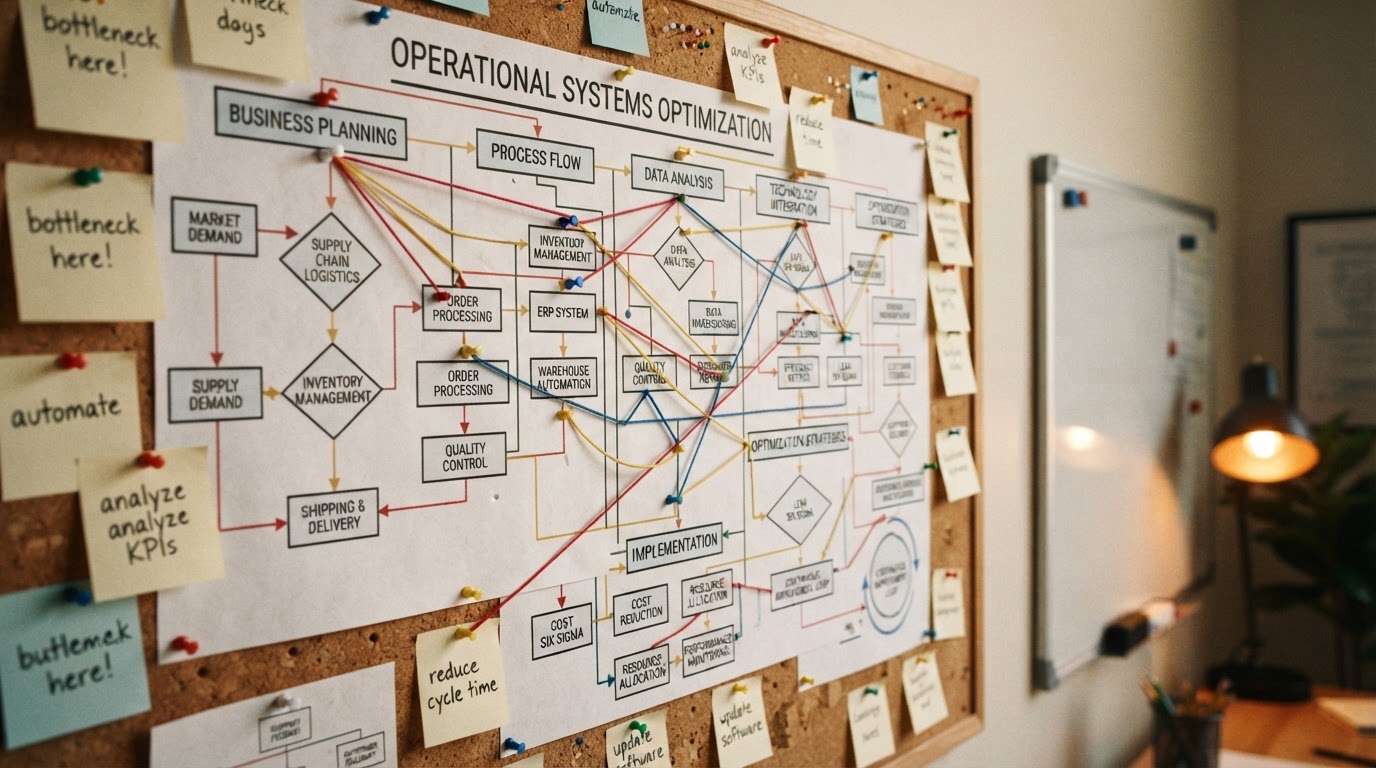
Operational friction is the most expensive thing a business cannot see. It does not appear on the income statement, yet it quietly consumes hours, erodes margins, and frustrates the people doing the work. Ashley Boswell and Damon Boswell approach operational systems optimization as a discipline of making the invisible visible — then removing it.
Mapping the Hidden Cost
Before you can optimize a process, you have to see it. Damon Boswell begins every operational engagement with process mapping — literally diagramming how work moves through the organization. The exercise almost always surfaces surprises: handoffs that no one owns, approvals that add days without adding value, and duplicate work that exists only because two teams never compared notes.
Research on continuous improvement in 2026 confirms that companies scaling operational excellence rely on exactly this kind of visibility — digitized idea capture, mapped workflows, and disciplined measurement. The tools matter less than the habit of looking.
The Three Levers
Ashley Boswell distills optimization into three levers that apply to nearly any process. First, eliminate — remove steps that add no value. Second, automate — let software handle repetitive handoffs. Third, sequence — reorder the remaining steps so work flows without waiting. The order matters; automating a broken process only makes the breakage faster.
- Eliminate: cut steps that add no value before touching anything else
- Automate: hand repetitive, rules-based work to software
- Sequence: reorder steps so work never sits idle waiting for a handoff
A process you have not mapped is a process you cannot improve. — Ashley Boswell
Building the Reporting Layer
Optimization is not a one-time event. It requires a reporting layer — KPIs that track cycle time, error rates, and throughput — so the team can see when friction creeps back in. Damon and Ashley install lightweight dashboards that give leaders visibility without burying them in data.
The businesses that scale cleanly are the ones that treat operations as a system, not a series of emergencies. If your team spends more time coordinating work than doing it, the system is the problem — and it is fixable.
Written by Ashley Boswell & Damon Boswell
Ashley Boswell & Damon Boswell lead Empowerment Blueprint LLC, delivering fractional C-suite strategy, operational discipline, and revenue engineering to founders and executives.