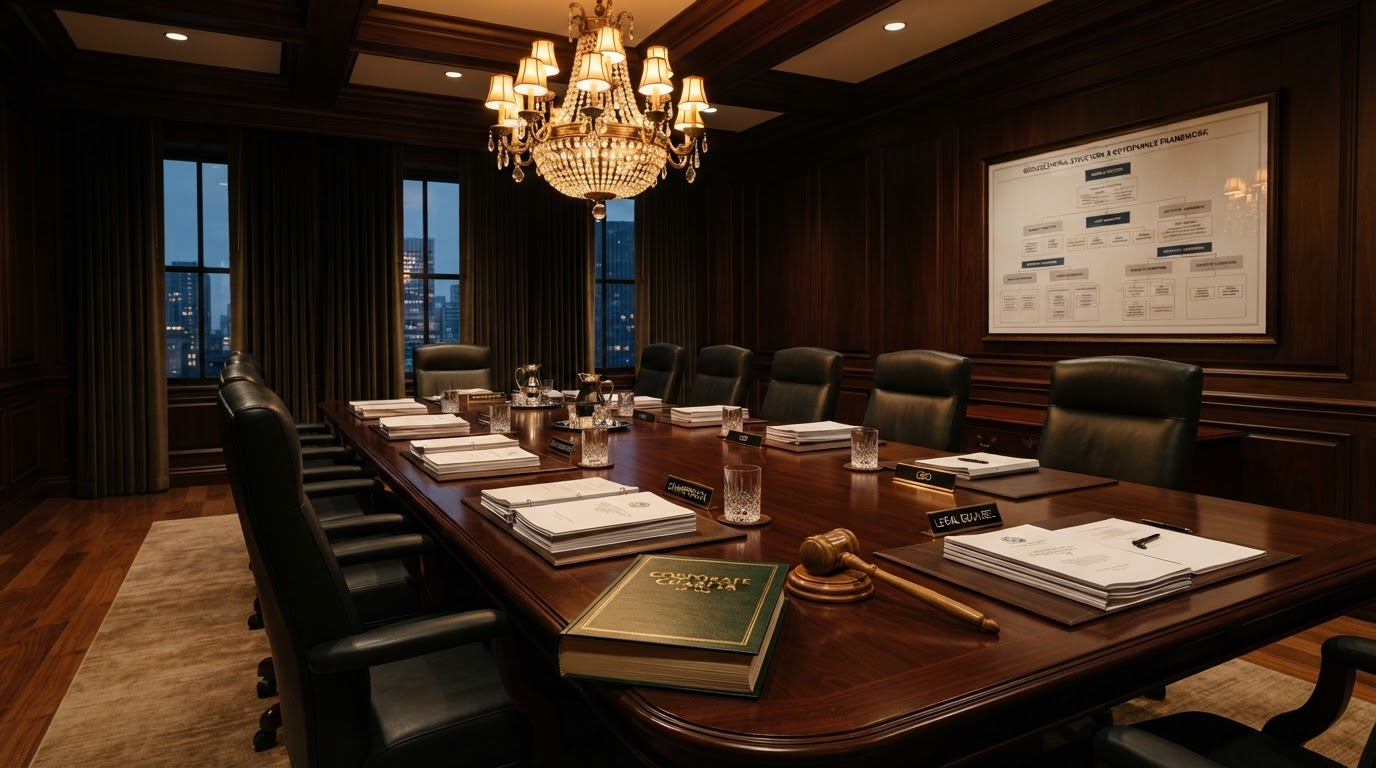
There is a pattern Ashley Boswell and Damon Boswell observe in nearly every company that crosses the threshold from founder-led practice to scalable enterprise, and it reveals itself in the questions the founder can no longer answer alone. The decisions have become heavier, the stakes have become broader, and the circle of people the founder can think out loud with has not grown to meet the weight. The founder is making consequential calls in isolation, surrounded by a team that executes but does not challenge, and the absence of a structured external voice is quietly converting good judgment into lonely judgment. The remedy is not another hire. It is governance architecture — the deliberate construction of an external body that brings counsel, challenge, and stewardship to decisions the founder should not be making alone.
The 2026 landscape on governance is clearer than founders often realize, and the distinction that matters most is the one between an advisory board and a board of directors. The research is consistent: an advisory board provides strategic counsel without legal liability, while a board of directors carries formal governance authority and the fiduciary obligations that accompany it. The two bodies are not interchangeable, and the choice between them is not a matter of preference. It is a matter of stage, structure, and the specific gap the company is trying to fill. Getting it wrong is expensive — the wrong body can impose obligations the company is not ready for, or deliver counsel too lightweight to move decisions that carry real consequence.
Counsel Versus Control
Damon Boswell frames the distinction in terms founders grasp immediately. An advisory board offers advice; a board of directors handles governance. Members of a board of directors hold legal decision-making authority and are authorized to act and make binding decisions on behalf of the organization. Members of an advisory board are not. The advisory body exists to sharpen the founder's thinking, to challenge assumptions, and to bring outside perspective into a room that has grown insular. It does not exist to govern, because governance carries liability, accountability, and a set of formal obligations that an advisory structure is deliberately designed to avoid.
The distinction matters because it determines what the body can and cannot do for the company. An advisory board can question a strategy, pressure-test an acquisition, and push the founder to confront an uncomfortable truth. It cannot bind the company to a decision, and that freedom is precisely what makes it useful at the stage where the founder still needs to retain decision authority while gaining access to judgment they do not possess internally. A board of directors, by contrast, can bind the company — and with that authority comes the fiduciary duty, the legal exposure, and the formal compliance obligations that make it the right instrument for a later stage and the wrong instrument for an earlier one.
- An advisory board provides strategic counsel without legal liability or binding authority over company decisions
- A board of directors carries formal governance authority, fiduciary duty, and legal accountability for the organization
- The advisory body is designed to ebb and flow with the company's needs, while a governance board must comply with bylaws and formal structure
- The choice between them is determined by stage, ownership structure, and whether the founder needs counsel or needs to share decision authority
The Stage Question
Ashley Boswell is precise about the sequencing, because the most common error is reaching for the wrong body at the wrong time. A company that is still founder-owned, pre-institutional-capital, and operating below the complexity threshold that demands formal governance does not need a board of directors. It needs an advisory board — a small, deliberate group of operators who have navigated the stage the company is entering and who can offer counsel the founder's internal team cannot. The advisory board ebs and flows with the company's needs, expanding when a specific challenge demands specific expertise and contracting when that expertise has been absorbed. It is lightweight, flexible, and unburdened by the formal structure a governance board requires.
The transition to a formal board arrives when the company's structure demands it — when institutional investors take seats, when the ownership base broadens, when the scale of decisions crosses a threshold where shared authority becomes a legal and practical necessity rather than a preference. The research is clear that growing businesses often benefit from both, used in sequence and sometimes in parallel: an advisory board for the counsel the founder still needs, and a governance board for the decisions the structure now requires. The companies that reach for a governance board too early impose obligations they are not ready to manage. The companies that reach for an advisory board too late are already operating with decisions that should have had external challenge long before they got one.
Lonely judgment is not the same as good judgment. The founder who has no one in the room qualified to disagree is making the company's biggest decisions inside an echo. — Ashley Boswell
What a Functional Advisory Board Actually Does
Damon Boswell is careful to distinguish a functional advisory board from the social construct that too often passes for one. A real advisory board is not a roster of impressive names assembled for the credibility of the list. It is a small group — three to five members is the functional maximum, because beyond that the conversation degrades — selected for a specific reason: each member has navigated a challenge the company is currently facing or is about to face. The composition is deliberate, the cadence is regular, and the agenda is driven by the real decisions on the founder's desk rather than by topics the members happen to find interesting.
The practical rhythm Ashley and Damon install is quarterly, with a pre-read distributed in advance so the meeting time is spent in discussion rather than presentation. The pre-read is short — the current state of the business, the two or three decisions on the horizon, the specific questions the founder wants the board to weigh. The meeting is a working session, not a performance, and the output is not minutes. It is sharper thinking and a founder who leaves the room with more clarity than they entered with. The advisory board that functions this way earns its cost many times over. The advisory board that functions as a quarterly status update wastes the very thing it was assembled to provide.
The Composition Discipline
Ashley Boswell returns to composition as the variable that determines whether the body earns its keep. The temptation is to assemble members who resemble the founder, because resemblance is comfortable and challenge is not. The discipline is the opposite. The highest-value advisory board member is the one who disagrees with the founder productively — who has walked the path the founder is on, who sees the blind spot the founder cannot see from inside it, and who is willing to say the thing the internal team is reluctant to voice. A board composed entirely of agreement is a comfort, not a counsel, and it is the most expensive kind of echo chamber a growing company can construct.
The research reinforces the point: the value of external governance and counsel lies in perspectives the internal team lacks, and the body that delivers it is the one deliberately assembled for difference rather than for familiarity. The companies that build their advisory architecture around complementary expertise — a financial operator when the founder is a product mind, a go-to-market veteran when the company is entering a new channel, an exit-experienced advisor when a transaction is on the horizon — are the ones that extract compounding value from the structure. The companies that build it around impressive consensus extract a list of names and little else.
Stewardship as a Built Structure
Damon Boswell frames the whole discipline in terms that connect it to the firm's other work, because governance is not a separate practice. It is the capstone of the operating discipline Ashley and Damon install across every engagement. The company that has built the operating cadence, the single source of truth, and the leadership team that executes without founder escalation is the company ready to add the external stewardship layer that sharpens the decisions the founder still owns. The company that adds an advisory board before those foundations are in place is asking external voices to weigh in on a business that cannot yet act on the counsel it receives, and the mismatch produces frustration on both sides.
The end state is a founder who is no longer making the company's heaviest decisions in isolation — who has a deliberate body of experienced operators to challenge the thinking, pressure-test the bets, and surface the blind spots the internal team cannot see. Whether that body is advisory or governance depends on the stage, but the principle does not: the companies that scale with clarity are the ones that build the external stewardship their decisions require, and the companies that stall are the ones that rely on a founder's solitary judgment long after the decisions outgrew it.
If you are making decisions of growing consequence with no structured external voice in the room, the risk is not hypothetical — it is the silent cost of every call made without challenge. Ashley Boswell and Damon Boswell can help you determine whether an advisory board, a governance board, or a staged transition between them is right for your company, starting with a confidential assessment of the decisions on your horizon and the counsel they warrant.
Written by Ashley Boswell & Damon Boswell
Ashley Boswell & Damon Boswell lead Empowerment Blueprint LLC, delivering fractional C-suite strategy, operational discipline, and revenue engineering to founders and executives.